
Is Your Holiday Let Legit? The UK Staycation Platform Safety Index 2026
With UK staycations now rivalling overseas holidays in popularity, Schofields scored seven of the most popular booking platforms on how well they actually protect you – and found an alarming gap between the safest and most dangerous.
This is important because in a world where consumers almost exclusively book and buy online, it can be difficult to distinguish between a safe, secure booking platform – and one that just looks that way.
Why Schofields did this research
As the UK’s specialist holiday home insurance experts – insuring thousands of properties from Cornwall to the Cairngorms – we have a clear view of what legitimate holiday lets look like, and what happens when things go wrong.
The data is worrying. There were 6,066 reports of holiday fraud made to Action Fraud in 2024, with holidaymakers losing a combined total of £11,183,957. July was the highest month for reports, with 647 in that month alone. At the same time, staycations are booming – for the first time in recent years, industry data shows more Brits plan a UK holiday than an overseas trip. As the staycation market grows, so does the opportunity for fraud.
Three key statistics highlight the scope of the issue:
- £11.18 million was lost to holiday fraud in 2024 (Action Fraud)
- 52% of Brits now plan a UK staycation over going abroad, according to industry data
- More than half of all 2024 holiday fraud reports mentioned social media platforms (Action Fraud)
We assessed six of the most commonly used booking channels against six consumer protection criteria – including an original analysis of fraud-related Trustpilot reviews across all seven platforms – producing the first Holiday Let Safety Index focused specifically on UK staycation bookings.
The main types of holiday let fraud in 2026
Fake property listings
Scammers list properties they don’t own, collect deposits or full balances, and disappear – leaving customers to arrive at holiday lets that don’t exist. The average loss per victim in 2024 was £1,844, barely unchanged from the year before (Action Fraud).
AI-generated listings
Fraudsters now use AI image tools to create entirely fictional properties – using realistic photographs of cottages, gardens and bedrooms that don’t exist. These are posted alongside made-up descriptions and AI-written reviews, creating extremely convincing listings. In recent research, when UK adults were asked to identify AI-generated property images, over 60% could not spot a fake.
Clone websites
Fake versions of real travel sites, which often appear high in paid search results during peak booking periods. It’s almost impossible to tell these apart from the real thing on a mobile screen. Customers enter their details and card payments, which go straight to the fraudsters who have set them up.
Phishing via legitimate platforms
Action Fraud has specifically warned that Booking.com customers are being targeted via the platform’s own messaging system, after scammers take over legitimate hotel accounts. Between June 2023 and September 2024, this generated 532 reports and £370,000 in losses.
Off-platform payment requests
The biggest red flag at any stage is a request to pay by bank transfer, separate payment link, or messaging app outside of the booking platform. Once sent, the money is often irretrievable, and this is how most holiday fraud victims lose it.
The Holiday Let Platform Safety Index 2026
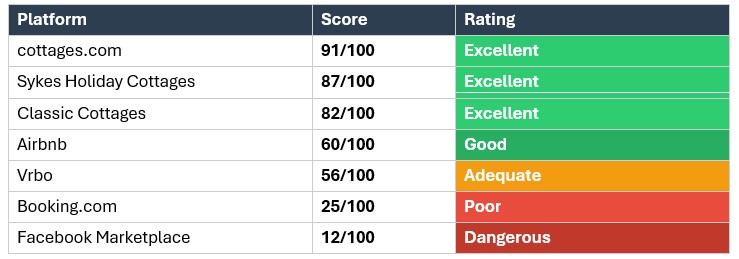
Platform breakdown
cottages.com – 91/100 – Excellent
The highest-scoring platform in our index is cottages.com. The site benefits from an agent model that is far safer than open marketplaces. Every property is inspected by a member of their property team before going live, meaning fraudulent listings cannot realistically appear. As an ABTA member, cottages.com is subject to a Code of Conduct enforced by an independent body – and guests have access to a Chartered Trading Standards Institute-approved dispute resolution process if things go wrong.
The one limitation is that ABTA’s financial protection does not apply to UK accommodation-only bookings, meaning guests are not automatically protected against the company going under in the way they would be with a package holiday.
Our analysis of Trustpilot reviews found that just 32 of the platform’s 101,269 reviews mention fraud – a rate of 0.03%, the joint lowest of any platform in our study alongside Sykes.
| Category | Weight | Score /20 | Weighted |
| Host ID verification | ×0.75 | 15 | 11.25 |
| Property and listing verification | ×1 | 20 | 20 |
| Guest payment protection | ×1.5 | 15 | 22.5 |
| Fraud detection and removal | ×1 | 20 | 20 |
| Consumer resolution | ×1.25 | 20 | 25 |
| Trustpilot fraud mention rate | ×1 | 20 | 20 |
| Total | 91/100 |
Sykes Holiday Cottages – 87/100 – Excellent
The UK’s largest independent cottage agency scores strongly across every category. Sykes physically inspects properties before they go live and operates a signed owner contract model, meaning every property owner is known to the business, and fraudulent listings are prevented at the point of listing rather than having to be removed. Payments are processed by Sykes rather than directly to owners, providing an extra layer of financial protection, plus the company offers a 24/7 emergency helpline.
Sykes scores slightly lower than cottages.com because some guests report being redirected to property owners when disputes arise, rather than receiving immediate resolution from Sykes itself.
Our analysis of Trustpilot reviews found that just 36 of Sykes’ 184,822 reviews mention fraud – a rate of 0.02%, the lowest of any platform in our study.
| Category | Weight | Score /20 | Weighted |
| Host ID verification | ×0.75 | 15 | 11.25 |
| Property and listing verification | ×1 | 20 | 20 |
| Guest payment protection | ×1.5 | 15 | 22.5 |
| Fraud detection and removal | ×1 | 20 | 20 |
| Consumer resolution | ×1.25 | 15 | 18.75 |
| Trustpilot fraud mention rate | ×1 | 20 | 20 |
| Total | 87/100 |
Classic Cottages – 82/100 – Excellent
Like Sykes and cottages.com, Classic Cottages operates an agent model with a signed owner contract, comprehensive compliance requirements, and a 24/7 emergency line. Properties are physically inspected before going live, and Classic’s compliance team maintains certificates centrally and sends renewal reminders to owners.
Classic scores slightly lower than Sykes on consumer support. While it operates a responsive customer service team, it is not an ABTA member, meaning guests do not have access to the formal CTSI-approved dispute resolution process available through cottages.com. Some Trustpilot reviews indicate complaints are occasionally deflected back to property owners rather than resolved directly by Classic.
Our analysis of Trustpilot reviews found that none of Classic Cottages’ 645 reviews mention fraud – a rate of 0%, the joint lowest in our study. However, it is worth noting that Classic’s Trustpilot review base is significantly smaller than the other specialist agencies, which means this figure should be treated with slightly more caution.
| Category | Weight | Score /20 | Weighted |
| Host ID verification | ×0.75 | 15 | 11.25 |
| Property and listing verification | ×1 | 20 | 20 |
| Guest payment protection | ×1.5 | 15 | 22.5 |
| Fraud detection and removal | ×1 | 20 | 20 |
| Consumer resolution | ×1.25 | 10 | 12.5 |
| Trustpilot fraud mention rate | ×1 | 20 | 20 |
| Total | 82/100 |
Airbnb – 60/100 – Good
Airbnb is the strongest of the open marketplace platforms on prevention, largely because it holds payment until 24 hours after check-in, giving guests time to flag problems before funds are released to the host. Host IDs must also be verified and there is active location checking for listings.
Airbnb also offers AirCover for guests – included free with every booking – which provides support if a host cancels prior to check-in, a guest is unable to check in, or a listing is significantly different from what was advertised. In those circumstances Airbnb will help find a similar place or provide a full or partial refund.
However, Airbnb has the highest fraud mention rate of any platform in our study – higher even than Booking.com. Our analysis found that 266 of its 16,932 Trustpilot reviews mention fraud, a rate of 1.57%, and the platform carries a 1.3-star rating overall, driven largely by poor customer service when things go wrong.
| Category | Weight | Score /20 | Weighted |
| Host ID verification | ×0.75 | 15 | 11.25 |
| Property and listing verification | ×1 | 15 | 15 |
| Guest payment protection | ×1.5 | 20 | 30 |
| Fraud detection and removal | ×1 | 15 | 15 |
| Consumer resolution | ×1.25 | 5 | 6.25 |
| Trustpilot fraud mention rate | ×1 | 0 | 0 |
| Total | 60/100 |
Vrbo – 56/100 – Adequate
Vrbo is relatively weak on prevention, but better than most on resolution. Its host identity verification is optional – guests can book without a host having verified at all – which is a significant gap. But its Book with Confidence Guarantee assigns a dedicated team member to complaints and provides rebooking assistance, making it more responsive than Airbnb when problems arise.
Our analysis found that 385 of Vrbo’s 118,991 Trustpilot reviews mention fraud – a rate of 0.32%, which scores well and is consistent with a platform that, while imperfect on prevention, handles complaints more proactively than other marketplaces.
| Category | Weight | Score /20 | Weighted |
| Host ID verification | ×0.75 | 5 | 3.75 |
| Property and listing verification | ×1 | 10 | 10 |
| Guest payment protection | ×1.5 | 10 | 15 |
| Fraud detection and removal | ×1 | 10 | 10 |
| Consumer resolution | ×1.25 | 15 | 18.75 |
| Trustpilot fraud mention rate | ×1 | 15 | 15 |
| Total | 56/100 |
Booking.com – 25/100 – Poor
Booking.com scores poorly across every category, with many well-documented issues around consumer protection. A Which? investigation found that a property could be listed in under 15 minutes with no passport or driving licence required – unlike on Vrbo or Airbnb. When investigators checked back months after flagging fraudulent properties, they found yet more listings with hundreds of scam-warning reviews still available to book.
Action Fraud has also specifically warned about Booking.com account takeover fraud, in which scammers hijack legitimate hotel accounts and use the platform’s own messaging system to request payments from guests.
Our Trustpilot analysis found that 1,156 of Booking.com’s 109,906 reviews mention fraud – a rate of 1.05%, the second highest of any platform in our study. It is also known to hide behind its position as a marketplace, pointing guests to contest any issues with the owners themselves rather than offering solid protection through the platform.
| Category | Weight | Score /20 | Weighted |
| Host ID verification | ×0.75 | 5 | 3.75 |
| Property and listing verification | ×1 | 5 | 5 |
| Guest payment protection | ×1.5 | 5 | 7.5 |
| Fraud detection and removal | ×1 | 5 | 5 |
| Consumer resolution | ×1.25 | 5 | 6.25 |
| Trustpilot fraud mention rate | ×1 | 5 | 5 |
| Total | 25/100 |
Facebook Marketplace – 12/100 – Dangerous
Facebook Marketplace scores just 12 out of 100. In four of the six categories it scores zero. There is no host identity verification, no property checking, no payment protection, and no real consumer support if things do go wrong. Payments are almost always made by bank transfer, which Action Fraud confirms is essentially unrecoverable once sent.
More than half of all holiday fraud reports to Action Fraud mention social media platforms. Facebook does not verify that the person posting any listing actually owns or manages the property.
Our Trustpilot analysis found that 121 of Facebook’s 18,185 reviews mention fraud – a rate of 0.67%. Of course, people defrauded via Facebook Marketplace may not think to review Facebook itself on Trustpilot. The real-world fraud rate on the platform is therefore almost certainly higher than this figure suggests.
| Category | Weight | Score /20 | Weighted |
| Host ID verification | ×0.75 | 0 | 0 |
| Property and listing verification | ×1 | 0 | 0 |
| Guest payment protection | ×1.5 | 0 | 0 |
| Fraud detection and removal | ×1 | 5 | 5 |
| Consumer resolution | ×1.25 | 0 | 0 |
| Trustpilot fraud mention rate | ×1 | 10 | 10 |
| Total | 12/100 |
Five things to check before booking any holiday let – advice from Schofields
- Book through a recognised platform or agency. UK specialist cottage agencies like Sykes, Classic Cottages and cottages.com physically inspect properties before listing. Open marketplaces do not.
- Never pay by bank transfer. Always pay by credit card through the platform’s own payment system. Bank transfers are the payment method of choice for fraudsters because they are essentially unrecoverable.
- Reverse image search the property photos. Right-click any listing photo and search Google Images. If the same images appear on another platform at a different price or location, it is likely a scam.
- Read reviews carefully – and check the dates. A listing with reviews all posted in the same week, or with no reviews at all, warrants extra caution before booking.
- Be suspicious of any pressure to pay outside the platform. Legitimate hosts and agencies do not need you to pay via a separate bank account or messaging app. Any such request is a warning sign.
Our methodology
We scored each platform across six categories, each marked out of 20, based on publicly available platform policies, third-party research, and our own original analysis of Trustpilot review data. Scores were then weighted to give the final figure /100.
- Host identity verification
- Property and listing verification
- Guest payment protection
- Fraud detection and removal
- Consumer resolution
- Trustpilot fraud mention rate
Sources
- Action Fraud: Holiday fraud data 2024 – 6,066 reports, £11,183,957 lost, July peak month (647 reports), average loss £1,844. https://www.reportfraud.police.uk/holiday-fraud/
- Action Fraud / Travel Weekly: More than half of 2024 holiday fraud reports mentioned social media platforms
- Action Fraud: Booking.com account takeover fraud warning – 532 reports between June 2023 and September 2024, £370,000 lost
- Which? investigation, 2024/2025 – Booking.com listing created in under 15 minutes without ID; fraudulent properties with scam-warning reviews remaining live after being flagged. which.co.uk
- Help Net Security, July 2025 – AI-generated property images: 34% of UK adults mistakenly identified AI images as real; 27% unsure. TripAdvisor removed 2.7 million fake reviews in 2024. helpnetsecurity.com
- Airbnb newsroom – Identity verification requirements for all hosts; 24-hour payment hold policy; AirCover terms. news.airbnb.com
- Vrbo help pages – Optional identity verification; Book with Confidence Guarantee terms. help.vrbo.com
- com – ABTA membership; property inspection commitment; CTSI-approved dispute resolution. cottages.com
- Sykes Holiday Cottages – Property standards and physical inspection process; owner contract model; 24/7 emergency line. sykescottages.co.uk
- Classic Cottages – Owner compliance requirements; property inspection process; 24/7 emergency line; B Corp certification. classic.co.uk
- co.uk UK Staycation Statistics 2026 – 52% of Britons plan a UK staycation vs 46% overseas. partyhouses.co.uk/uk-staycation-statistics
- Schofields Insurance analysis – Trustpilot fraud mention rates across all seven platforms, May 2026. Data: Booking.com 1,156/109,906 · Sykes 36/184,822 · Facebook Marketplace 121/18,185 · Airbnb 266/16,932 · cottages.com 32/101,269 · Vrbo 385/118,991 · Classic Cottages 0/645